Physical Address
304 North Cardinal St.
Dorchester Center, MA 02124
Physical Address
304 North Cardinal St.
Dorchester Center, MA 02124

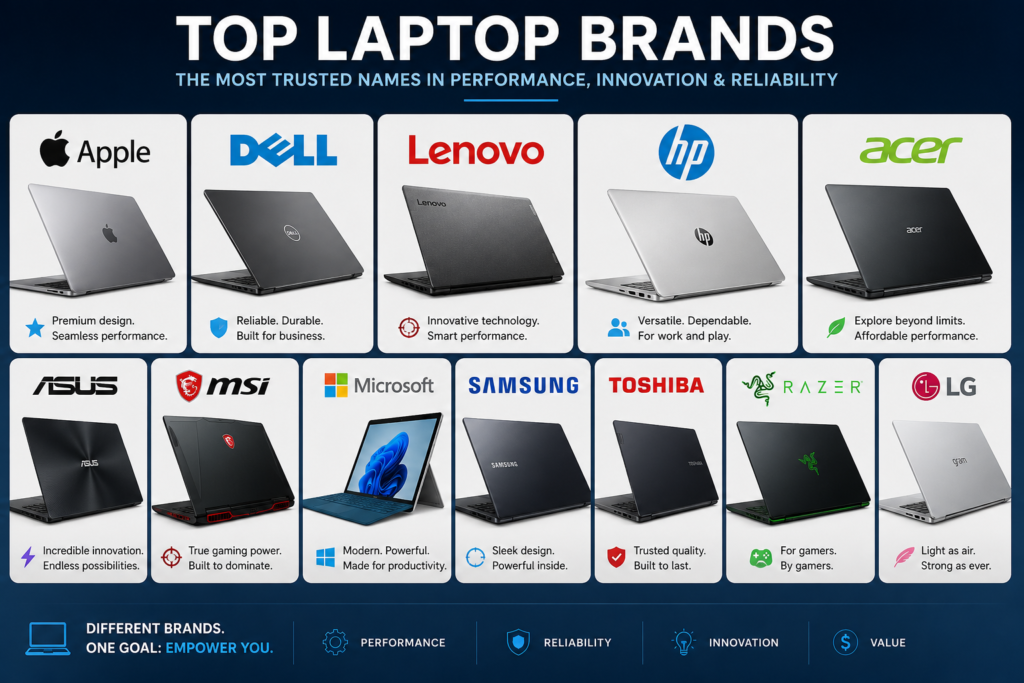
Buying a laptop is about more than choosing the latest processor or the largest SSD. Every laptop brand has its own strengths, design philosophy, and target audience. Some excel in gaming, while others focus on business, creativity, portability, or affordability.
In this guide, we’ll explore the world’s most popular laptop brands, what each one does best, and the type of user each brand is designed for.
Apple’s MacBook lineup is known for its premium build quality, exceptional battery life, Retina displays, and seamless integration with the Apple ecosystem. Powered by Apple Silicon (M-series chips), MacBooks deliver outstanding performance while remaining quiet and energy efficient.
Recommended for: Graphic designers, video editors, photographers, programmers, students, and professionals.
Dell offers one of the widest laptop portfolios in the market. The XPS series is famous for premium ultrabooks, while Latitude and Precision models are trusted by businesses for durability, security, and performance.
Recommended for: Business users, engineers, programmers, and office professionals.
Lenovo is especially known for its ThinkPad lineup, which is widely recognized for durability, outstanding keyboards, and reliability. Yoga laptops offer premium 2-in-1 flexibility, while Legion models are popular among gamers.
Recommended for: Students, programmers, writers, business professionals, and remote workers.
ASUS has become one of the most innovative laptop manufacturers. Its ZenBook series focuses on portability, ROG (Republic of Gamers) dominates gaming, and ProArt targets creative professionals. ASUS is also known for experimenting with unique designs like dual-screen laptops.
Recommended for: Gamers, YouTubers, designers, engineers, and students.
HP offers laptops for virtually every budget. Spectre models compete in the premium market, Envy targets creators, EliteBook serves business users, and Pavilion is popular for everyday computing.
Recommended for: Families, students, professionals, and small business owners.
Acer focuses on affordable laptops while still offering powerful gaming machines through its Predator and Nitro series. It’s one of the best choices for value-conscious buyers.
Recommended for: Students, home users, and first-time laptop buyers.
MSI specializes in high-performance laptops with powerful CPUs and dedicated NVIDIA graphics. Many of its laptops are designed for gaming, 3D rendering, CAD software, and video production.
Recommended for: Gamers, architects, engineers, and professional creators.
Microsoft Surface laptops combine premium design with excellent portability and seamless Windows integration. They’re lightweight, stylish, and ideal for mobile professionals.
Recommended for: Executives, students, writers, and business travelers.
Samsung Galaxy Book laptops integrate seamlessly with Galaxy smartphones and tablets. They’re lightweight, feature vibrant AMOLED displays, and are ideal for productivity.
Recommended for: Samsung smartphone users, students, and office workers.
Razer produces premium gaming laptops with sleek aluminum designs, high-refresh-rate displays, and top-tier graphics performance. They are often compared to MacBooks in build quality but are optimized for Windows gaming.
Recommended for: Gamers, streamers, video editors, and 3D artists.
| Brand | Biggest Strength | Best For |
|---|---|---|
| Apple | Battery life & ecosystem | Creators, students, professionals |
| Dell | Business reliability | Office, engineering, enterprise |
| Lenovo | Keyboard & durability | Students, programmers, business |
| ASUS | Innovation & gaming | Gamers, creators, students |
| HP | Variety & value | Home, office, education |
| Acer | Budget-friendly | Students, casual users |
| MSI | Gaming power | Gamers, engineers |
| Microsoft | Portability | Business travelers, students |
| Samsung | AMOLED displays | Galaxy users, office work |
| Razer | Premium gaming | Gamers, creators |
There is no single “best” laptop brand. The ideal choice depends on your budget, workflow, and personal preferences. Apple excels in premium productivity and creative work, Lenovo and Dell dominate the business market, ASUS and MSI lead in gaming and innovation, while Acer and HP provide excellent value for everyday users. Before making a purchase, compare not only the brand but also the specific model, processor, RAM, storage, display quality, battery life, and after-sales support to ensure you choose the laptop that best fits your needs.